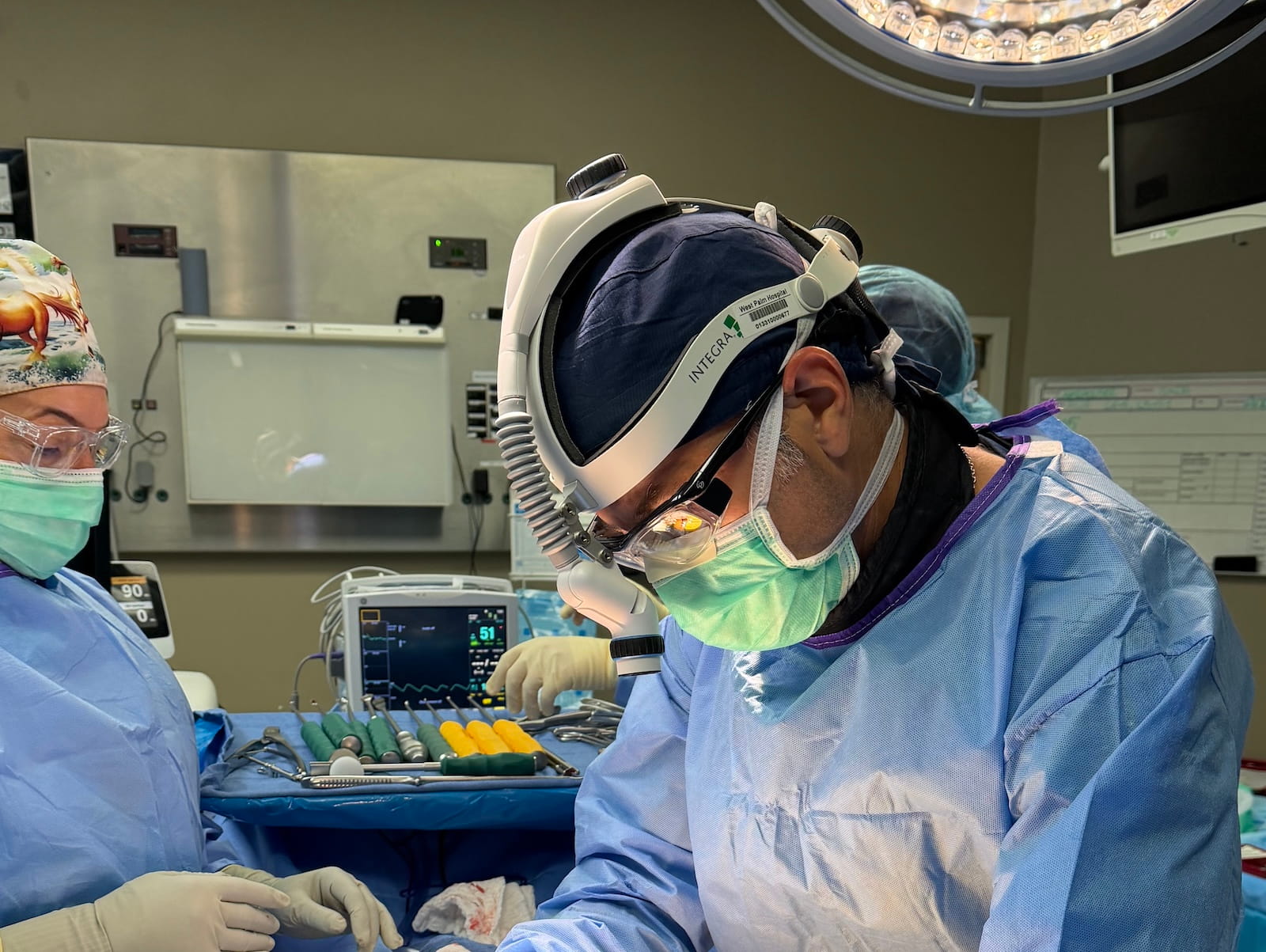
Artificial disc replacement can be a strong option for certain people with disc-related neck or back pain, especially when the goal is to treat the damaged disc while preserving motion.
But not everyone with a herniated disc, degenerative disc disease, or chronic spine pain is a candidate.
The right fit depends on your symptoms, imaging, spinal stability, bone quality, joint health, and long-term goals. In many cases, the most important question is not whether artificial disc replacement exists. It is whether it makes sense for your specific spine.
What Is Artificial Disc Replacement?
Artificial disc replacement is a motion-preserving spine procedure. During surgery, the damaged disc is removed and replaced with an artificial implant designed to help maintain movement at that spinal level.
It may be performed in the neck or lower back, depending on the condition and anatomy involved. Unlike spinal fusion, which stops motion at the treated level, disc replacement is designed to preserve motion when the spine is stable enough to support it.
Signs You May Be a Candidate for Artificial Disc Replacement
You may be a candidate for artificial disc replacement if your pain is clearly linked to one or more damaged discs and your spine still has the structure needed to support a motion-preserving implant.
In general, good candidates often have:
- Disc-related neck or back pain
- Arm or leg symptoms caused by disc-related nerve compression
- Imaging that matches the location of their symptoms
- Symptoms that have not improved enough with conservative care
- Preserved motion at the affected spinal level
- Good spinal stability
- Healthy enough bone quality
- No severe arthritis in the nearby facet joints
Candidacy is not based on one MRI finding alone. Many people have disc changes on imaging, but not all of those changes are the true source of pain. A careful evaluation helps connect the symptoms, exam findings, and imaging before surgery is considered.
Conditions Artificial Disc Replacement May Help Treat
Artificial disc replacement may be considered for certain patients with conditions such as degenerative disc disease, herniated discs, and disc-related nerve compression.
In the cervical spine, this may include neck pain with arm pain, numbness, tingling, or weakness caused by pressure on a nerve.
In the lumbar spine, candidacy is often more selective. The lower back carries more weight and is closely affected by spinal alignment, facet joint health, and stability. For that reason, lumbar disc replacement requires a very detailed evaluation.
A diagnosis alone does not determine whether artificial disc replacement is the right option. The full spinal picture matters.
Who May Not Be a Good Candidate?
Some patients are better suited for a different treatment. That may include non-surgical care, decompression, fusion, or another surgical approach.
Artificial disc replacement may not be recommended if you have:
- Severe facet joint arthritis
- Significant spinal instability
- Advanced osteoporosis or poor bone quality
- Severe spinal deformity
- Infection, tumor, or fracture
- Severe narrowing caused mostly by bone overgrowth
- Pain that does not clearly come from the disc
- Prior surgery or anatomy that makes disc replacement less appropriate
This does not mean there are no options. It simply means that preserving motion may not be the safest or most effective strategy for that spinal level.
Cervical vs. Lumbar Disc Replacement Candidacy
Cervical and lumbar disc replacement are both designed to preserve motion, but candidacy can look different depending on the area of the spine being treated.
Cervical Artificial Disc Replacement
Cervical disc replacement is used in the neck. It may be considered when a damaged disc is causing neck pain, arm pain, numbness, tingling, or weakness.
Many patients ask about cervical disc replacement as an alternative to fusion. For the right candidate, it may help relieve nerve pressure while maintaining motion in the neck.
Lumbar Artificial Disc Replacement
Lumbar disc replacement is used in the lower back. It may be considered when pain is coming from a damaged lumbar disc and the surrounding joints, bones, and spinal alignment are appropriate for motion preservation.
This is where patient selection is especially important. Facet joint arthritis, instability, or poor bone quality can make lumbar disc replacement less suitable.
What Your Spine Surgeon Looks for During an Evaluation
A disc replacement evaluation is about more than confirming a damaged disc. The goal is to understand whether replacing that disc would actually improve pain, protect function, and make sense for the way your spine moves.
Your surgeon will look at how your symptoms started, what makes them better or worse, how they affect daily life, and whether the painful level can safely support an artificial disc. They will also consider your activity goals, previous treatments, and whether another option may offer a better long-term result.
This helps narrow the plan to what fits your spine, not just what fits the diagnosis.
Is Artificial Disc Replacement Better Than Fusion?
Artificial disc replacement and fusion are used for different reasons. Disc replacement may be preferred when the spine is stable and motion preservation makes sense. Fusion may be better when a spinal level needs more stability.
The right choice depends on your anatomy, diagnosis, and long-term goals.
Questions to Ask If You Are Considering Artificial Disc Replacement
If you are exploring artificial disc replacement, these questions can help guide your consultation:
- Is my pain clearly coming from the damaged disc?
- Does my imaging match my symptoms?
- Is my spine stable enough for disc replacement?
- Do I have facet joint arthritis?
- Am I a better candidate for cervical or lumbar disc replacement?
- Would fusion or decompression make more sense?
- What are the risks in my specific case?
- How many spinal levels may need treatment?
- What should I expect during recovery?
A good consultation should leave you with a clearer understanding of your options, not more confusion.
When to Get an Artificial Disc Replacement Evaluation
Consider an evaluation if disc-related neck or back pain is limiting your daily life and conservative care has not provided enough relief. It may also be worth discussing if you have arm or leg pain, numbness, tingling, or weakness that appears to be connected to a damaged disc.
You do not need to know whether you qualify before meeting with a spine specialist. The purpose of the evaluation is to find out which options fit your condition.
Schedule an Artificial Disc Replacement Consultation
Palm Beach Spine & Disc Replacement Center provides advanced evaluation for patients considering artificial disc replacement, motion preservation, and alternatives to fusion. Led by Dr. Jason M. Cuéllar and supported by an experienced clinical team, the center helps patients understand their options with clarity and confidence.
Patients in Palm Beach and beyond can contact Palm Beach Spine & Disc Replacement Center to schedule a consultation.